PhD in Economics
(+420) 224 005 161
Curriculum & Faculty
From rigorous training to real-world impact
CERGE-EI’s PhD in Economics combines advanced coursework, independent research, and close faculty mentorship to train outstanding economists
Years 1–2: Core Foundation
Students undertake intensive coursework in microeconomics, macroeconomics, statistics, and econometrics, culminating in general exams. The first year is structured with compulsory courses, including:
- Microeconomics I & II: Covering consumer and producer theory, game theory, and applications.
- Macroeconomics I & II: Focusing on dynamic economic models, growth theory, and business cycle analysis.
- Econometrics I: Introducing parametric regression models, maximum likelihood estimation, and bootstrap inference.
- Academic Writing I: Enhancing professional-level writing and presentation skills.
In the second year, students choose from a range of electives to deepen their specialization. Successful completion of coursework and exams leads to a U.S.-accredited MA in Economics.
The goal of the course is to introduce tools necessary to understand and implement empirical studies (evaluations of causal effects) with cross-sectional and panel data. Heterogeneous treatment effects and dynamic panel data models fall outside of the scope of the course, as do machine learning techniques and AI. Examples from applied work will be used to illustrate the discussed methods. Note that the course covers much of the work of the Nobel prize laureates for 2000 and 2021. The main reference textbook for the course is Econometric Analysis of Cross Section and Panel Data, Jeffrey M. Wooldridge, MIT Press 2002. I provide suggestions for reading and additional references throughout the lecture notes (available on my homepage). This course is designed for second-year PhD students interested in microeconomic theory and game theory. It introduces selected topics in these fields, guides students toward current research frontiers, and equips them with the tools needed to begin conducting independent research. This course covers important aspects of modeling the dynamics of time series data, from both macroeconomics and finance. We will first discuss principles of time series modeling and model selection procedures. Then, we will study models for conditional mean dynamics such as linear and nonlinear autoregressions, primarily related to macroeconomic data, as well as models with unobserved processes. We will also study methods of dealing with structural instability and the notion and applications of Brownian motion. Then, we will turn to modeling conditional variance and other measures of financial return volatility. Finally, we will cover modeling conditional quantiles, probabilities and densities, related to both macro and financial data. We will study several papers that represent the current state of macroeconomic research. The topics include financial flows across countries, the interaction between fiscal policy and foreign debt management, and inflation driven by fiscal policy. We will also choose additional papers to study in class. The course will provide fundamental understanding of stylized labor supply and demand in their static and advanced versions, and associated models of wage determination. The course will combine theoretical concepts, empirical evidence and empirical methods including use of econometrics and individual level data. Policy and mechanism designs debates involving students will be encouraged. This is the first part of the Public Finance sequence. The second part will be taught by Teresa Freitas-Monteiro in Spring 2027. The course will discuss various experimental approaches, such as lab experiments, lab-in-field experiments, randomized control trials, and survey experiments. The focus will be on (i) experiments that test ideas from behavioral economics (social preferences, social norms, identity, time discounting and limited self-control, limited attention, etc.) and (ii) experiments that are primarily motivated by important economic and social issues (poverty, discrimination, inter-group conflicts). More broadly, the course aims to show the value of primary data collection in terms dealing with identification issues, testing competing theoretical predictions and more precise measurement. This is a second-year graduate-level course. The course is based on selected and (mostly) recent empirical research papers focusing on particular aspects of the economic history of the United States, paying particular attention to the topics of internal and international migration, cities, innovation, and culture. Beyond providing students with an in-depth understanding of the research frontier in US economic history, the course will focus on developing skills in developing, communicating, presenting, and evaluating research ideas and causal research designs in applied economics more broadly. AW II supports ongoing development of professional English and skills required to produce MA/PhD academic papers and publishable texts through explicit study of in-field language and genre. Students process their writing via continuing revision of draft work from the idea stages to the final version, in response to peer and instructor feedback. Instructors provide individual consultations and extended written feedback, aimed to support each student in developing his/her individual writing skills. A peer feedback process is applied to all written submissions, and a peer review of the final paper draft comprises a significant portion of the course grade. Building upon the work in Academic Writing 1, each student will research, plan, and write a practice Research Proposal on a topic of his or her choice. The paper should both analyze the work of others and present the students’ own distinct position on the topic. The paper will be marked on its exposition; the economic ideas expressed in it are not evaluated on ASC courses. This paper can form a basis or thought exercise for a more developed research proposal in spring 2027. The course aims at getting the second year Ph.D. students familiar with the basics and subtleties of how the academic economic science works and how academic economists do research, publish academic papers, make academic presentations and find their jobs. We will also review resources available on the Internet and aspects of academic integrity. The main topics of the class are econometric approaches to the problem of sample selection and (individual-level) heterogeneity. While the methods apply more generally, the class will focus on methods to address the selection problem from the program evaluation literature and place particular emphasis on heterogeneity in randomized control trials in the second part of the course. TBA This module constitutes the second half of the course “Modeling in Macro and Finance.” It focuses on empirical finance, with applications to corporate finance, empirical banking, and the finance-and-growth nexus. The aim of this portion of the course is to equip students with a methodological toolkit and practical understanding of cross-sectional and panel-data techniques commonly employed in empirical finance research. 1. The increasing complexity in the analysis of theoretical and applied dynamic macroeconomic models—primarily due to the lack of available analytic solutions for most of them, and when they do exist, they are often trivial simplifications of the original problem—necessitates the use of efficient numerical methods in macroeconomics. A half of this part of the course is devoted to elementary concepts of numerical analysis and basic numerical methods, while the second half focuses on numerical methods for solving dynamic macroeconomic models. Students will be expected to write their own simple programs and run application programs and toolboxes in MATLAB. In this course, we focus on three topical issues that affect modern labor markets: migration, technological development, and inequality. In the first part, we study the determinants of migration, impacts on host countries' labor markets, attitudes towards migrants, and refugee migration. In the second part, we review the literature on the effects of automation and artificial intelligence (AI) on the labor market. We discuss the central questions of whether AI is "different'' from other technological shocks, and how it will affect workers across the skill and wage distribution. The third part focuses on inequality, intergenerational mobility, and discrimination. Using the example of job recommendation systems, we will also critically discuss the risks of adopting AI in public policy. The objective of this course is to introduce students to the core topics in Public Economics at the graduate level. Public Economics studies the role of the government in the economy and the implications of its policies for individuals. In this course, we will analyze how market failures can create a potential role for government intervention and study the issues that can arise when governments operate under imperfect information. The course evaluates both the efficiency and equity implications of public policies, studying how interventions affect individual incentives, behavioral responses, and welfare. Throughout the semester, we will cover topics such as tax policy, inequality, social insurance, and public goods. The course will combine theoretical models with empirical work and will cover both classical and recent studies. Students should have a work-level knowledge of Microeconomics Theory and Econometrics/Policy Evaluation. Why are some countries rich and others poor? This course explores how societies develop—and why poverty persists—through a comparative approach grounded in economic history, culture, and political economy. We study whether contemporary development differences have historical origins and analyze the channels through which history shapes development, focusing on domestic institutions, culture, and geography. Examples include the legacies of the slave trade, colonialism, and religion. The course builds on teaching material from Harvard University and covers both foundational contributions—such as work by Nobel laureates Acemoglu, Johnson, and Robinson—and the research frontier of recent years. Although the focus is on economic methods, the questions intersect with history, psychology, political science, anthropology, and geography. Students learn rigorous empirical methods, including identification strategies such as instrumental variables and regression discontinuity designs, as well as survey data collection, randomized controlled trials, and GIS tools. Each student develops an original research project, presents it throughout the course, and submits a final version. This is the final required credit course for the Academic Skills Center. The seminar is designed primarily to assist dissertation proposal workshop participants with their written research proposals and presentations via consultation with Academic Skills Center faculty. For DPW candidates, the seminar will work towards the first official DPW draft due November 1st (or when the SAO announces). Consultations will continue through DPW week. All students deliver a practice presentation of their research proposals prior to DPW week. Students not wishing to participate in DPW can complete the course requirements by participating in all elements of the course without final attendance at DPW. The Research Methodology Seminar is a structured sequence of activities designed to guide second-year PhD students through the early stages of independent research. Its primary objective is to help students identify promising research questions, refine preliminary ideas into viable projects, and prepare effectively for the DPW. An information meeting will be held in the fall semester. CS2 MA is a consultation-based course with one introductory lecture designed to support students writing a master’s paper in fulfillment of the US MA degree requirement at CERGE-EI. Enrollment in CS2 MA is a requirement for submitting an MA paper. The SAO will notify you if you are enrolled in CS2MA and will inform you of when the introductory lecture will be held. Years 3–5: Research and Teaching "Visiting a vibrant research department challenged my perspective on academia and research. We often lose sight of our research agenda getting caught up in the details of our daily lives in an environment that has become a comfort zone for us. Spending a semester in a completely new setting is challenging, fulfilling, and also a privilege. I have had the opportunity to have quality conversations with people in my field and I firmly believe this experience has opened a new chapter in my academic career." Sofiana Sinani, CERGE-EI PhD student, "My research stay at Princeton has been an incredibly enriching experience. Engaging with world-class faculty, receiving invaluable feedback on my work, and participating in both academic and social events have been highly motivating. These experiences have broadened my perspectives and deepened my commitment to impactful research in development and behavioral economics. This opportunity has truly been a highlight of my academic journey." Salamatu Nanna Adam, CERGE-EI PhD student, "My research stay at Columbia University was a transformative experience that deepened my understanding of the field and expanded my perspectives. Being there allowed me to present my work at several internal workshops and conferences, where I received valuable feedback from faculty members and students. These opportunities were crucial in helping me improve my research and prepare for the job market. I also attended workshops and seminars at other universities in the city, which connected me with a diverse academic community. Through these experiences, I build new contacts and explore opportunities for future collaborations." Tran Tranh Trang, CERGE-IE PhD student, Here is a selected list of institutions where CERGE-EI students have done their mobility in the past few years:
Elective Subjects - Fall Semester
Please note that the list of the elective subjects may differ slightly each year. The following list is thus subject to change.
Microeconometrics I
Lecturer: Štěpán Jurajda
Advanced Microeconomics I:
Behavior, Information, and IncentivesLecturer: Filip Matějka / Yiman Sun
Econometrics of Macro and Financial Data
Lecturer: Stanislav Anatolyev
Advanced Macroeconomics I
Lecturer: Byeongju Jeong
Labor Economics I
Lecturer: Daniel Münich
The course has three major goals (i) to guide students through current theoretical and empirical understanding of major labor market issues, (ii) to promote student’s own empirical research on topic selected, (iii) to make students familiar with stylized research resources, field standards and approaches. Throughout the topics, empirical methodological approaches will be clarified (data and econometric / identification techniques).
The prerequisites are principles of microeconomic theory, statistics and econometrics from the 1st year.
Public Finance
Lecturer: Ctirad Slavík
The title of this part could be ‘Macroeconomic aspects of public finance’. As such, this course can be divided into two parts.
Part 1. In order to discuss issues related to taxation in macroeconomic heterogeneous-agent models, we will first need to set up these models. This will be the first part of the course. Here, we will discuss issues related to heterogeneity and inequality. We will start by characterizing the solution to a heterogeneous agent model with complete markets and conclude that the dynamics implied by the model are not consistent with real-world data. We will then analyze models in which markets are (exogeneously) incomplete - either because not all assets are traded (there is only one risk-free asset) or there are borrowing constraints. First, we will characterize the solution to individual agents' problems when the interest rate is fixed (partial equilibrium) with, first, deterministic and, second, stochastic, income fluctuations. Next, we will study general equilibrium versions of these models without and with aggregate risk.
Part 2. In the second part of the course, we will move on to discussing papers that are studying taxation in heterogeneous agent models.
Experimental Economics
Lecturer: Michal Bauer
Economic History of the United States
Lecturer: Sebastian Ottinger
Academic Writing II
Lecturer: Academic Skills Center
Resesarch Methodology Seminar
Lecturer: Stanislav Anatolyev
Elective Subjects - Spring Semester
Microeconometrics II
Lecturer: Nikolas Mittag
Advanced Microeconomics II:
Dynamic contractingLecturer: Maxi Guennewig
Empirical Macro and Finance
Lecturer: Stephanie Ettmeier / Alexander Popov
Advanced Macroeconomics II:
Computational EconomicsLecturer: Michal Kejak
2. In this course, we will discuss issues related to heterogeneity and inequality. We will start by characterizing the solution to a heterogeneous agents model with complete markets and conclude that the dynamics implied by the model are not consistent with real-world data. We will then analyze models in which markets are (exogeneously) incomplete - either because not all assets are traded (there is only one risk-free asset) or there are borrowing constraints. First, we will characterize the solution to individual agents' problems when the interest rate is fixed (partial equilibrium) with, first, deterministic and, second, stochastic, income fluctuations. Next, we will study general equilibrium versions of these models without and with aggregate risk.
Labor Economics II
Lecturer: Achim Ahrens
Public Economics
Lecturer: Teresa Freitas-Monteiro
Development Economics
Lecturer: Clara Sievert
Combined Skills I
Lecturer: Academic Skills Center
Research Methodology Seminar
Lecturer: Yiman Sun , Sebastian Ottinger
Elective Subjects - Summer Semester
Combined Skills II - MA only
Lecturer: Academic Skills Center
Students should consult with both the ASC instructor and the Economics instructor on their plans for the paper in terms of type and proposed content early in the semester.
The papers are graded on the CS2MA course as per normal ASC writing standards. They must pass on the Economics side for content in order for an MA degree to be awarded.
Doctoral candidates focus on original dissertation research under faculty supervision and gain teaching experience as Teaching Assistants.
A distinctive feature of the program is the opportunity to participate in funded Research Stays at leading universities and research institutions around the world. These study stays, typically lasting 2-4 months, allow students to collaborate with international scholars, access specialized datasets and research facilities, and expand their professional networks. Host institutions in recent years have included top programs in Europe, North America, and Asia. A significant part of associated costs, including travel and living expenses, are covered, and students continue to receive their regular CERGE-EI stipend during their stay.
Students are encouraged to publish in the CERGE-EI Working Paper Series, present at international conferences, and engage in the rich seminar culture at both CERGE-EI and their host institutions.
Graduates earn both a Czech doctoral degree and a U.S.-chartered PhD, recognized internationally. 
Research stay at University of Copenhagen,
Center for Economic Behavior and Inequality (CEBI) in 2024

Research stay at Princeton University,
Research Program in Development Economics in 2024

research stay at Columbia University,
School of International and Public Affairs,
Center on Global Economic Governance in 2024
Northern American Universities: Boston University, Columbia University, Harvard University, Massachusetts Institute of Technology, New York University, Princeton University, Stanford University, University of California at Berkeley, University of Chicago, University of Minnesota, University of Pennsylvania, Yale University and others
European Universities: Cambridge University, Institute of Advanced Studies (IAS) - Vienna, Copenhagen Business School, Pantheon-Sorbonne, Tinbergen Institute - Amsterdam, Università Luigi Bocconi - Milan, Université Libre de Bruxelles, University College London, University of Essex, University of Oxford, University of Paris I, University of Tilburg - Center for Economic Research, University of Zurich and others
Read more about our students' experiences on our blog.
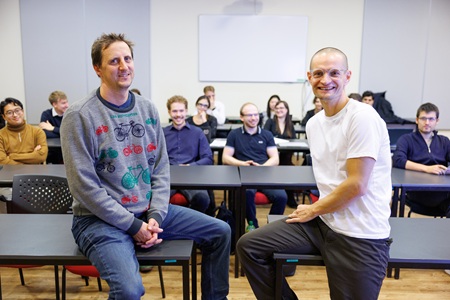 Ideas that travel, mentors who lead
At CERGE-EI, students learn from economists contributing to major advances in the field. Our faculty—over 20 scholars from top institutions with joint appointments at Charles University and the Czech Academy of Sciences—publish in leading journals such as Econometrica, AER, and the Review of Economic Studies, and cover fields from macro, labor, development, theory, econometrics, behavioral economics or economic history. They win Europe’s most competitive research grants, including ERC grants and top international and national awards. Students learn from scholars who push the boundaries of economic research – and work directly alongside them.
You can view profiles of our professors here.